
Institutional treasury teams rely on TRON every day to move stablecoins quickly and cost-effectively. But accessing liquidity has traditionally required leaving the security of their wallet infrastructure, introducing additional operational steps, approval gaps, and compliance challenges.
Liminal now supports secure stablecoin swaps on the TRON network directly within its wallet platform. Treasury teams can execute swaps while continuing to follow their existing approval workflows, security policies, and compliance controls, all without moving assets to external wallets or fragmented workflows.
Whether you’re managing exchange liquidity, facilitating cross-border payments, or optimizing treasury operations, Liminal wallet allows you to access one of the world’s largest stablecoin ecosystems through a single governed workflow.
Current Institutional Stablecoin Landscape
Stablecoins have become the backbone of institutional digital asset operations, enabling exchanges, OTC desks, payment providers, and financial institutions to settle transactions and manage liquidity across blockchain networks.
The global stablecoin market surpassed $321 billion in 2026, with USDT exceeding $190 billion in circulation. TRON alone hosts over $89 billion of USDT, nearly 47% of the total supply, making it one of the leading networks for institutional stablecoin transfers. Source
As stablecoin activity grows, treasury teams are swapping assets more frequently. The challenge isn’t the swap itself, it’s executing it without leaving secure wallet infrastructure or compromising governance and compliance.
Problems with Traditional Stablecoin Swap Workflows
For many institutions, swapping stablecoins is still a fragmented process that relies on external wallets, bridges, and decentralized exchanges. While these workflows enable access to liquidity, they often come at the cost of operational efficiency, security, and governance.
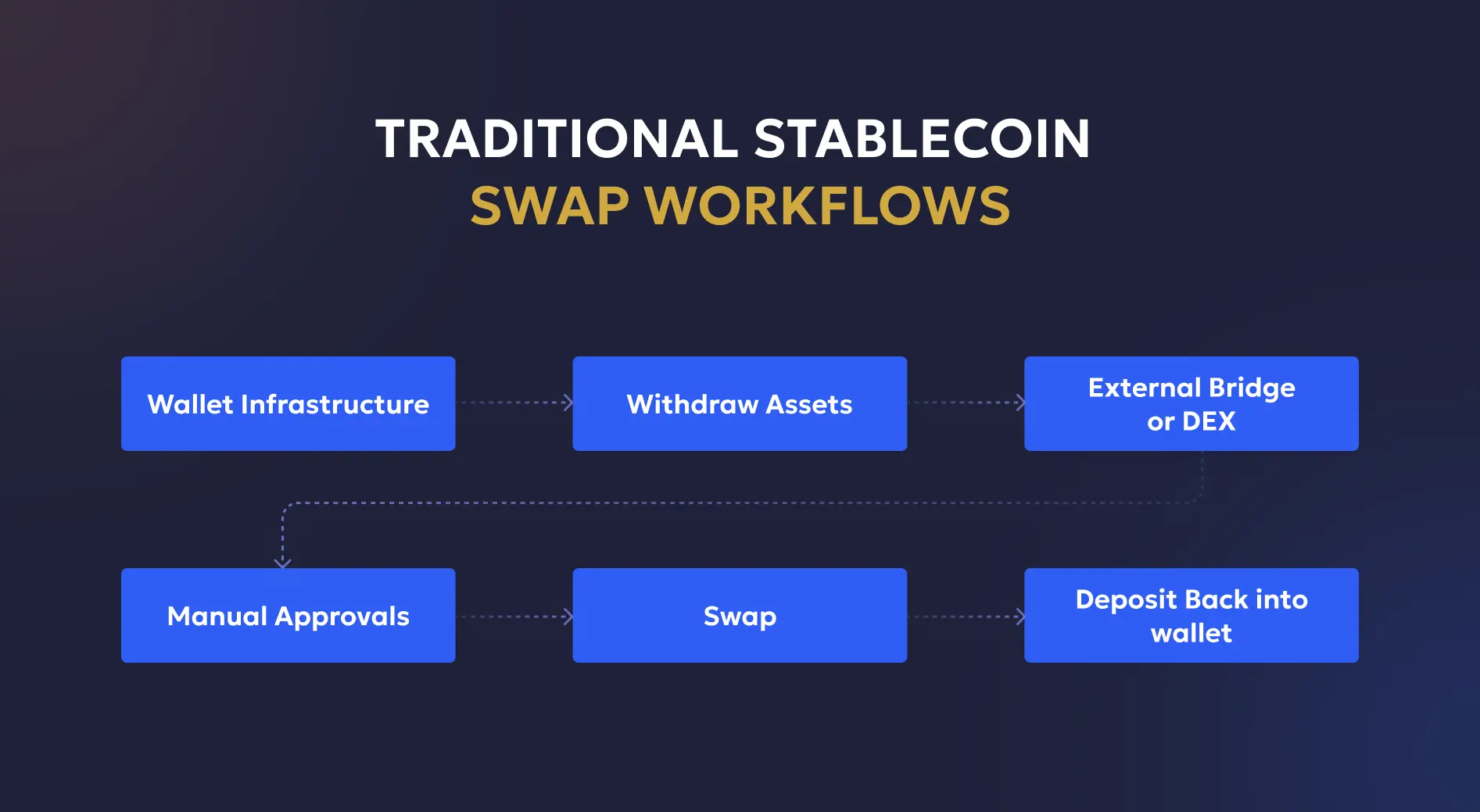
The most common challenges include:
- Governance and Approval Controls Are Disrupted: When swaps occur outside the wallet platform, existing approval workflows, role-based permissions, and transaction policies may no longer apply consistently. This creates gaps in governance and increases operational risk.
- Limited Visibility into Security and Compliance: Interacting with external bridges, DEXs, and smart contracts introduces additional security considerations. Without integrated risk screening and centralized monitoring, institutions have less visibility into the counterparties and smart contracts they interact with.
- Operational Complexity Increases: Executing a single swap often requires switching between multiple platforms, coordinating manual approvals, and managing separate operational workflows. This adds unnecessary friction to what should be a routine treasury operation.
- Reduced Auditability: With activities spread across multiple tools and platforms, maintaining a complete audit trail becomes more challenging. This can complicate internal governance, operational reviews, and regulatory reporting.
What’s New: Swap Stablecoins on TRON With Liminal
TRON is one of the largest networks for stablecoin activity. With Stablecoin Swaps on TRON, treasury teams can now swap stablecoins directly within their existing Liminal wallet infrastructure, without moving assets to an external platform.
- No new infrastructure.
- No changes to existing approval processes.
- Every swap continues to operate inside your organization’s existing governance framework.
(Stablecoin Swaps are also supported across Ethereum, BNB Chain, Polygon, and Base.)
How Liminal Enables Secure, Governed Stablecoin Swaps
Executing a stablecoin swap is only one part of the process. For institutional teams, it’s equally important that every swap adheres to the same governance, security, and operational standards as any other treasury transaction. That’s exactly how swaps on TRON is designed, with controls built into every stage of the workflow.
- Governed Approval Workflows: Every swap follows your organization’s existing maker-checker workflows, role-based permissions, and approval policies. Treasury teams can execute swaps without creating exceptions to established governance processes.
- Smart Contract Risk Screening: Before a swap is executed, the destination smart contract is automatically screened. If a contract is identified as malicious or high risk, the transaction is blocked before execution, helping reduce exposure to smart contract threats.
- Controlled Destination Addresses: Swaps can only be executed to approved destination wallets and supported smart contracts, helping organizations reduce operational risk and maintain compliance with internal treasury policies.
- One Platform, One Workflow: From initiating and approving a swap to monitoring its completion, the entire process takes place within Liminal. There’s no need to move between platforms, external bridges, or decentralized exchanges, giving treasury, security, and compliance teams a single, auditable workflow.
Conclusion
Institutional treasury teams are managing more assets, across more networks, than ever before. As these operations become increasingly interconnected, the future of digital asset operations isn’t about adding more tools, it’s about bringing critical treasury workflows into a single, controlled environment. As institutions continue to expand across blockchain ecosystems, the ability to manage liquidity without increasing operational complexity will be a defining characteristic of modern wallet infrastructure.
Execute TRON swaps through a secure, policy-driven wallet platform