


In the world of finance, stablecoins have quietly emerged as one of the biggest narratives. With a total turnover of over 40 trillion dollars and around 9 trillion dollars in real-world payments in 2025, they are on track to match the largest bank and card networks. What began as a tool for crypto traders is now used for cross-border business payments, treasury movements, and everyday payouts.
The following section explains what stablecoins are, how a stablecoin payment actually operates, and why institutions call for the appropriate wallet infrastructure in order to use them securely on a large scale.
What is a Stablecoin?
A stablecoin is a digital asset designed to maintain a stable value; typically, one token is worth one US dollar. Although it still operates on a blockchain similar to Ethereum or Tron, it is not designed to fluctuate daily like Bitcoin.
A digital IOU for a dollar is a simple method to conceptualise it. Sending someone $100 USDC should always be valued roughly $100, not $80 one day and $120 the next. They can hold it, spend it, or convert it back to regular money through an exchange or payment provider.
Stablecoins are already present in consumer wallets, commercial payment flows, and exchanges. They provide businesses with a very useful solution: combining the predictable nature of cash with the speed and reach of cryptocurrencies.
Main Types of Stablecoins and how they stay ‘stable’
Most stablecoins fit into three main groups, each with a different way of keeping that one-dollar target.
Fiat-backed stablecoins like USDC and USDT are kept in short-term government bonds or bank accounts. The issuer wants to hold one dollar, or a very close amount, for each token. To let users see what supports the token, multiple sources publish reports regularly. These are the most widely used for payments.
Cryptocurrency-backed stablecoins are secured by other cryptocurrency assets. Since the value is typically overprotected, you might lock up $150 worth of cryptocurrency to generate $100 worth of stablecoin. Smart contracts watch the value of the collateral and can force adjustments if prices fall. DeFi frequently uses this architecture; however, it increases market risk.
Algorithmic or hybrid stablecoins seek to maintain their anchor mostly through programming and incentives, rather than full reserves. Some high-profile projects failed when market conditions changed, which is why most institutions today opt for well-reserved, fiat-backed alternatives.
Fiat-backed stablecoins from transparent, regulated issuers are typically chosen for payment use, particularly in banks and fintechs.
Read More – Different Types of Stablecoins
How does a stablecoin payment actually work?
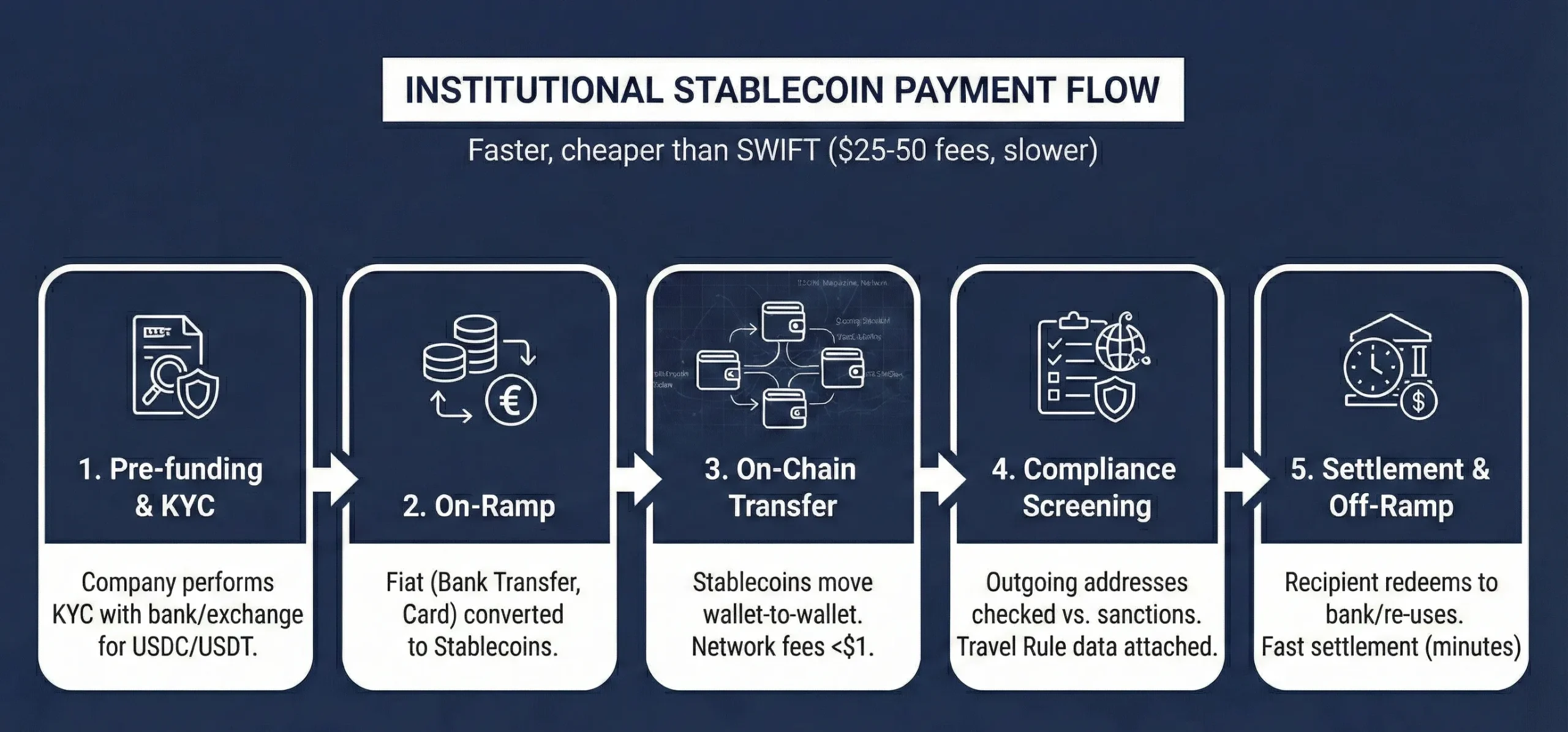
Sending stablecoins may look simple from the outside, but for institutions, there are several steps and controls built into the process.
Institutional stablecoin payment flow:
- Pre-funding and KYC: The company conducts KYC with a bank, fintech partner, or exchange that issues or distributes stablecoins such as USDC or USDT.
- On-ramp: Bank transfers, treasury allocations, or card payments made through a compliant provider are ways that fiat gets changed into stablecoins.
- On-chain transfer: Stablecoins move wallet to wallet on a chosen network (Ethereum, Tron, Solana, etc.) with network fees typically under $1.
- Compliance Screening: Outgoing addresses are checked against sanctions lists and whitelists. Travel Rule data (sender/receiver info) is attached for regulatory compliance.
- Settlement and off-ramp: After seeing the tokens quickly (in a matter of seconds to minutes), the recipient can either redeem them in their bank account or use them again for future payments or treasury operations.
Stablecoin payments settle in a matter of minutes across many corridors, requiring far fewer middlemen to apply FX spreads or request paperwork than with SWIFT, which typically charges a transaction fee of $25 to $50.
Why businesses and banks care about stablecoin payments
Businesses and financial organisations find stablecoins appealing for a few obvious reasons.
Faster settlement: Payments can be cleared at any time of day, almost instantly. Waiting for cutoff periods or bank operating hours is not necessary.
Reduced costs: Charges are reduced when there are fewer middlemen, particularly for cross-border transactions and smaller tickets.
Global reach: Even though there aren’t many local banking options, anyone with a suitable wallet can get stablecoins. In emerging markets, this is important for suppliers, independent contractors, and creators.
Programmability: Stablecoin payments can have restrictions, including dividing a single payment among multiple recipients or disbursing funds automatically upon delivery confirmation, because they are based on smart contract platforms.
This can result in faster cross-organisation money transfers, more effective treasury operations, and improved customer experiences for clients who demand instant digital payments from banks or major corporations.
Learn more – how stablecoins reduce costs and delays in cross-border payments.
Real World stablecoin payments examples
Stablecoins are already utilised in a number of commonplace situations.
Instead of using a conventional wire transfer, a business that pays foreign suppliers can send USDC. Funds are received by the supplier within minutes, and, if necessary, can be converted to local currency.
Stablecoins can be used by marketplaces and gig platforms to pay workers or merchants, avoiding the lengthy wait times and expensive fees that come with international payouts.
In order to circumvent the delays associated with traditional bank transfers, trading firms and funds employ stablecoins to transfer liquidity rapidly between exchanges, custodians, and on-chain protocols.
The fundamental advantage is the same in all situations: money flows more quickly and directly while remaining valued in a recognisable currency like the US dollar.
Risks, regulation, and what institutions look at
Along with the benefits, serious users must deal with some significant risks.
- Reserve and issuer risk: A fiat-backed stablecoin’s worth is determined by the quality and liquidity of its reserves. Issuers with transparent reporting and oversight are typically given preference by institutions.
- Technology risk: Stablecoins depend on underlying blockchains and smart contracts. Transactions may be delayed or disrupted by bugs, delays, or attacks.
- Policy and compliance: Even if the payment takes place on a blockchain, travel regulations, penalties, and anti-money laundering laws still apply.
A comprehensive structure for payment stablecoins, including guidelines for reserves and risk management, is intended to be established by new regulations like the GENIUS Act in the US. Guidelines about stablecoins’ place in the larger financial system are also being released by central banks and international organisations.
This implies that selecting the appropriate stablecoins is only half the task for banks. They also require appropriate care, supervision, and governance.
The importance of institutional grade custody and wallets
For a retail user sending $100, a basic web or mobile wallet might work just well. For a bank, exchange, or major corporation moving millions, it is insufficient.
Typically, organisations depend on specialised digital asset infrastructure that can:
- To prevent a single point of failure, store keys using technologies such as hardware security modules or multi-party computation.
- Implement rules on who has the authority to authorise what payments, what restrictions are in place, and which addresses are on the whitelist.
- Offer complete audit trails, potential for settlement, and interaction with current payment, banking, or treasury systems.
Stablecoin payments will no longer be a stand-alone experiment but rather a logical extension of current financial activities once these constraints are in place.
Getting started with stablecoin payments
A straightforward starting point for an organisation or company interested in stablecoin payments is as follows:
- Define the use case: Choose if cross-border payouts, treasury transfers, consumer payments, or another method will be the first step.
- Choose networks and stablecoins: Prioritise well-regulated, fiat-backed stablecoins, and pick chains based on your tolerance for risk and cost.
- Establish policies and custody: Utilise monitoring, limitations, and approvals-supporting infrastructure that aligns with your internal governance.
- Execute a controlled pilot: Start with modest quantities and a limited number of partners, assess the outcomes, and then progressively increase.
The goal of stablecoins is not to immediately replace the banking system. They want to improve the flow of value by utilising digital tokens, which function similarly to currency but move at the speed of the internet. Institutions that carefully consider their options now will be better equipped to handle tokenised assets and money in the future.
In the world of finance, stablecoins have quietly emerged as one of the biggest narratives. With over $40 trillion in total turnover and around $9 trillion in real-world payments in 2025, they now rival the largest bank and card networks. What began as a crypto trading tool now powers cross-border business payments, treasury movements, and everyday payouts. This guide explains what stablecoins are, how payments work, and why institutions need secure wallet infrastructure to use them safely at scale.
Learn more about how stablecoins have evolved from “crypto” to a $46 trillion payment infrastructure. Download our latest report, The Walled Garden, here: