
Does your wallet infrastructure platform manage your TRON transaction costs, or just processes the transactions?
Most platforms stop at processing. The fees, the idle TRX, the failed transactions during volume spikes, that stays your problem. This guide breaks down how Liminal addresses each problem differently, and what that means for institutions running USDT on TRON at scale.

Learn More – How High-Volume Crypto Businesses Can Cut TRON Transaction Fees by Up to 30%
Problems Faced by Digital Asset Companies Processing TRX
- Transactions fail at peak volume. When wallets run dry, transactions don’t queue, they fail, but you still pay the attempt fee.
- Costs are unpredictable. TRX burn fluctuates with network conditions, making fee spend hard to forecast or control.
- No native tooling to fix it. Most wallet platforms support TRON but offer no built-in way to manage what it costs to run on it.
- Every transaction burns TRX. Each USDT transfer costs ~7 TRX in network fees, a burn that scales directly with your volume.
- Idle TRX earns nothing. The TRX sitting in custody to cover fees generates zero return between transactions.
Key Insight
In June 2026, TRON set a new all-time high three times in ten days, peaking at 14.55 million daily transactions. The network holds $85.4 billion in USDT, 98.6% of all stablecoins on TRON as of Q1 2026. Behind that volume are institutions collectively absorbing the full burn cost on every transfer, holding idle TRX reserves against a cost structure that runs continuously. The question is whether your wallet platform gives you the tools to change that. Source
What Other Wallet Providers Do (And Don’t Do)
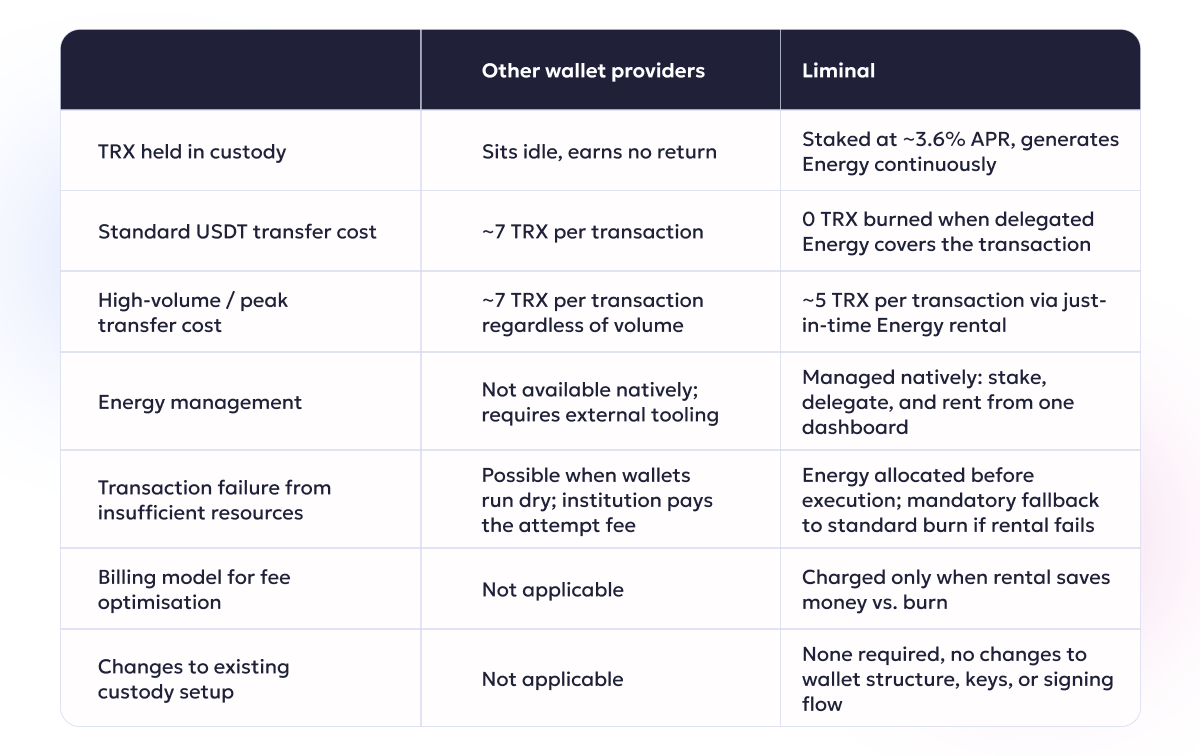
The majority of wallet infrastructure platforms available today support TRON as a network. When a USDT withdrawal is submitted, it’s broadcast to the TRON network and processed at the standard network rate.
They don’t typically include:
- Native TRON Energy management
- Staking integration that generates Energy for your wallets
- Delegation routing to active transaction wallets
- Just-in-time Energy rental when your position runs short
- Fallback handling when a transaction would otherwise fail
The result: your TRX burns at ~7 TRX per transaction. Your reserves sit idle. Your burn cost scales directly with your volume, and there’s no built-in way to reduce the cost.
For institutions processing thousands of TRX per day, it’s one of the largest controllable costs on the balance sheet and yet most platforms offer no way to address it.
How Liminal Handles TRON Transaction Fees
Where other platforms stop at processing your transactions, Liminal goes further. TRON Advantage is a complete fee management package built natively into the platform that tackles the TRON cost problem at every level.

Layer 1: Stake
TRX held in custody is staked through Liminal to generate two outputs simultaneously: approximately 3.6% APR on the staked amount, and a continuous supply of Energy that accrues to the institution’s wallet infrastructure. TRX reserves that previously sat idle now generate yield while also reducing the cost of every outbound transaction. Staking through Liminal is non-custodial. The TRX remains in the institution’s vault.
Layer 2: Delegate
The Energy generated through staking is routed to the institution’s active transaction wallets. Wallets with sufficient delegated Energy process USDT transfers without burning any TRX. For institutions with a staking position sized appropriately to their daily transaction volume, a significant portion of transfers can be executed at zero burn cost.
Delegation also changes how operational costs behave. Instead of a TRX burn that varies with network conditions and transaction volume, costs become predictable and can be forecasted in advance.
Layer 3: Optimise
For transactions where delegated Energy runs short: during volume spikes, or for institutions with smaller staking positions, the Optimise layer rents Energy from the TRON market just-in-time, before the transaction is submitted. The rental cost is approximately 5 TRX per transaction rather than 7 TRX under the native burn model. That is a reduction of approximately 30% per transaction.
Liminal bills only on transactions where the rental cost is lower than the burn cost. On transactions where the rental path is not cheaper, the transaction completes at the standard rate and Liminal charges nothing. The institution never pays more per transaction than they would have without the feature enabled.
Liminal vs Other Wallet Providers at a Glance
The Billing Model
Think of it like this: Liminal only charges you when it saves you money. If renting Energy is cheaper than burning TRX, the transaction runs on rented Energy and Liminal charges you for that rental. If for any reason renting isn’t cheaper or isn’t available, the transaction completes normally at the standard rate and Liminal charges you nothing extra.
You will never end up paying more per transaction than you would have without TRON Advantage switched on. layer also solves the failed transaction problem. Because Energy is secured before the transaction is submitted, it goes through on the first attempt every time without failed transactions, retry fees and manual reprocessing.
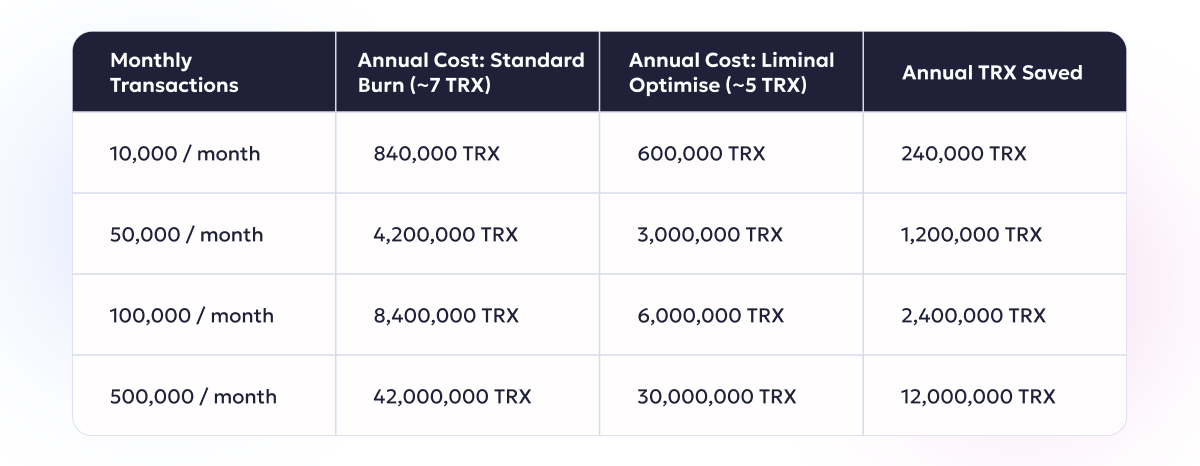
What the Difference Looks Like at Scale
The table below shows annual TRX fee costs under each model. Liminal figures reflect the Optimise layer only, savings from Delegate vary by staking position and are not included here
Is TRON Advantage Right for Your Business?
It’s a strong fit if:
- You’ve had transactions fail during busy periods and had to reprocess them manually
- You process USDT on TRON regularly, even a few thousand transactions a month adds up quickly
- You hold TRX in custody that is currently sitting idle and earning nothing
- You want your TRON fee costs to be predictable rather than variable